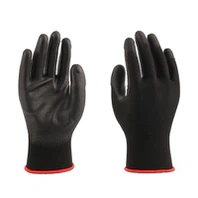
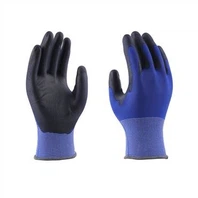
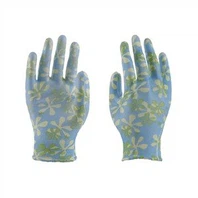
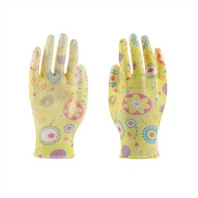
Elasticity is a crucial physical property that significantly impacts the functionality and performance of various products, including Pu Finger Coated Gloves. As a supplier of these gloves, understanding the concept of elasticity and its implications is essential for both product development and customer satisfaction.
Understanding Elasticity
Elasticity, in the context of materials science, refers to the ability of a material to deform under stress and return to its original shape when the stress is removed. This property is governed by Hooke's Law, which states that the force required to stretch or compress an elastic material is proportional to the displacement from its equilibrium position. In simpler terms, a highly elastic material can stretch a great deal without breaking and will snap back to its original form once the stretching force is released.
For Pu Finger Coated Gloves, elasticity plays a vital role in several aspects. Firstly, it affects the fit of the gloves. A glove with appropriate elasticity can conform to the shape of the hand, providing a snug yet comfortable fit. This is important because a well - fitting glove enhances dexterity, allowing the wearer to perform tasks with precision. For example, in industries such as electronics manufacturing or precision assembly, workers need gloves that can move with their fingers without restricting movement.
Secondly, elasticity influences the durability of the gloves. When a glove is stretched during normal use, an elastic material can withstand repeated stretching and bending without losing its integrity. This means that the glove is less likely to tear or develop holes, extending its lifespan and reducing the frequency of replacement.
Factors Affecting the Elasticity of Pu Finger Coated Gloves
Several factors can affect the elasticity of Pu Finger Coated Gloves. The type of polyurethane (PU) used in the coating is a primary factor. Different formulations of PU have varying degrees of elasticity. Some PU coatings are designed to be more rigid, providing better abrasion resistance but less elasticity. On the other hand, other formulations are engineered to be highly elastic, offering greater flexibility and comfort.
The thickness of the PU coating also plays a role. Thicker coatings generally reduce the overall elasticity of the glove because they are more resistant to deformation. However, a thicker coating may be necessary in applications where protection against chemicals, sharp objects, or high - impact forces is required.
The base material of the glove, which is often a knitted fabric, also contributes to the overall elasticity. Knitted fabrics can have different stitch patterns and fiber compositions, each with its own elastic properties. For instance, a glove made from a stretchy knitted nylon base will have different elasticity characteristics compared to one made from a cotton - based knit.
Measuring the Elasticity of Pu Finger Coated Gloves
There are several methods to measure the elasticity of Pu Finger Coated Gloves. One common approach is the tensile test. In a tensile test, a sample of the glove material is clamped at both ends and gradually pulled apart at a constant rate. The force required to stretch the sample and the amount of elongation are measured. The elastic modulus, which is the ratio of stress (force per unit area) to strain (elongation per unit length), can be calculated from these measurements. A higher elastic modulus indicates a stiffer material, while a lower modulus suggests a more elastic one.


Another method is the cyclic loading test. In this test, the glove sample is subjected to repeated cycles of stretching and relaxation. This simulates the real - world use of the gloves and helps to evaluate their ability to maintain elasticity over time. The amount of permanent deformation after a certain number of cycles can be measured to assess the long - term elastic performance of the gloves.
Applications and the Importance of Elasticity
The elasticity of Pu Finger Coated Gloves makes them suitable for a wide range of applications. In the PU Gardening Gloves category, elasticity is crucial for allowing gardeners to grip tools firmly and perform delicate tasks such as pruning or planting. A glove that can stretch with the hand's movements provides comfort during long hours of work and reduces hand fatigue.
In safety work, as seen in PU Coating Gloves For Safety Work, elasticity is important for ensuring that the gloves do not interfere with the worker's ability to handle equipment safely. For example, in construction or industrial settings, workers need gloves that can stretch to allow for a full range of motion while still providing protection against cuts, abrasions, and chemical exposure.
White PU Gloves are often used in cleanroom environments, such as in the semiconductor or pharmaceutical industries. The elasticity of these gloves is essential for maintaining a clean and sterile environment. A well - fitting, elastic glove reduces the risk of particles shedding from the glove into the cleanroom, which could contaminate sensitive products.
Quality Control and Elasticity
As a supplier of Pu Finger Coated Gloves, quality control is of utmost importance. We implement strict quality control measures to ensure that the elasticity of our gloves meets the required standards. This includes conducting regular tests on production samples to monitor the elastic properties of the gloves.
During the manufacturing process, we carefully select the raw materials, including the PU coating and the base fabric, to achieve the desired elasticity. We also control the coating process to ensure uniform thickness and proper adhesion of the PU to the base material, which can affect the overall elasticity.
Conclusion
The elasticity of Pu Finger Coated Gloves is a complex yet critical property that affects their fit, durability, and performance in various applications. By understanding the factors that influence elasticity, measuring it accurately, and implementing strict quality control measures, we can provide high - quality gloves that meet the diverse needs of our customers.
If you are interested in purchasing Pu Finger Coated Gloves for your specific application, we invite you to contact us for further discussion. We are committed to providing the best products and solutions to meet your requirements.
References
- Callister, W. D., & Rethwisch, D. G. (2012). Materials Science and Engineering: An Introduction. Wiley.
- ASTM International. (2019). Standard Test Methods for Tensile Properties of Textile Fabrics. ASTM D5034 - 19.