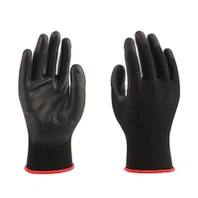
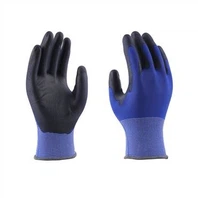
As a seasoned supplier of Black PU Gloves, I've encountered numerous inquiries regarding the anti-static properties of these gloves. In this blog post, I aim to delve into this topic comprehensively, shedding light on whether black PU gloves are anti-static and the factors that influence their anti-static capabilities.
Understanding Anti-Static Properties
Before we explore whether black PU gloves are anti-static, it's essential to understand what anti-static means. Static electricity is the imbalance of electric charges within or on the surface of a material. When two materials come into contact and then separate, electrons can transfer between them, creating a static charge. This static charge can cause various problems, such as attracting dust and debris, interfering with electronic devices, and even causing electrostatic discharges (ESDs) that can damage sensitive components.


Anti-static materials are designed to prevent the buildup of static electricity. They typically have a low surface resistance, which allows the static charge to dissipate quickly. This can be achieved through various methods, such as adding conductive materials to the material or treating the surface with an anti-static agent.
The Composition of Black PU Gloves
Black PU gloves are made by coating a base material, usually knitted or woven fabric, with a layer of polyurethane (PU). Polyurethane is a versatile polymer that offers several desirable properties, such as abrasion resistance, flexibility, and chemical resistance. The black color is typically achieved by adding a pigment to the PU coating.
The base material used in black PU gloves can vary depending on the intended application. Common base materials include nylon, polyester, and cotton. Each base material has its own unique properties, which can affect the overall performance of the gloves.
Are Black PU Gloves Anti-Static?
The answer to whether black PU gloves are anti-static is not straightforward. It depends on several factors, including the composition of the gloves, the manufacturing process, and the intended application.
In general, standard black PU gloves are not inherently anti-static. Polyurethane is an insulating material, which means it can easily accumulate static charge. However, it is possible to make black PU gloves with anti-static properties by incorporating conductive materials into the base fabric or the PU coating.
Conductive Materials
One common method of making black PU gloves anti-static is to use a conductive base fabric. Conductive fibers, such as carbon fibers or metal fibers, can be blended with the base material to create a fabric that has a low surface resistance. When the gloves are worn, the static charge can be conducted through the conductive fibers and dissipated to the ground.
Another approach is to add conductive particles to the PU coating. These particles can be made of materials such as carbon black or metal oxides. When the gloves are coated with the conductive PU, the static charge can be conducted through the particles and dissipated.
Anti-Static Treatments
In addition to using conductive materials, black PU gloves can also be treated with an anti-static agent. Anti-static agents are chemicals that can reduce the surface resistance of the gloves and prevent the buildup of static charge. These agents can be applied to the gloves during the manufacturing process or as a post-treatment.
Factors Affecting Anti-Static Performance
Even if black PU gloves are designed to be anti-static, their performance can be affected by several factors. These factors include:
Environmental Conditions
The humidity and temperature of the environment can have a significant impact on the anti-static performance of the gloves. In dry environments, static charge is more likely to build up, while in humid environments, the static charge can be dissipated more easily. Therefore, it's important to consider the environmental conditions when selecting anti-static black PU gloves.
Glove Usage
The way the gloves are used can also affect their anti-static performance. For example, if the gloves are rubbed against a rough surface or if they are in contact with other materials that generate static charge, the gloves may accumulate more static charge. Additionally, if the gloves are not properly grounded, the static charge may not be dissipated effectively.
Wear and Tear
Over time, the anti-static properties of the gloves may degrade due to wear and tear. The conductive materials or anti-static agents may be worn off or damaged, reducing the effectiveness of the gloves. Therefore, it's important to regularly inspect the gloves and replace them when necessary.
Applications of Anti-Static Black PU Gloves
Anti-static black PU gloves are commonly used in industries where static electricity can cause problems. Some of the applications include:
Electronics Manufacturing
In the electronics manufacturing industry, static electricity can damage sensitive electronic components. Anti-static black PU gloves are used to prevent the buildup of static charge and protect the components from ESDs.
Cleanroom Environments
Cleanrooms are used in industries such as semiconductor manufacturing, pharmaceuticals, and biotechnology. These environments require a high level of cleanliness and control to prevent contamination. Anti-static black PU gloves are used to prevent the generation of static charge, which can attract dust and debris and contaminate the cleanroom environment.
Printing and Packaging
In the printing and packaging industry, static electricity can cause problems such as paper jams, ink transfer issues, and product damage. Anti-static black PU gloves are used to prevent the buildup of static charge and ensure smooth operation of the printing and packaging equipment.
Conclusion
In conclusion, whether black PU gloves are anti-static depends on several factors. Standard black PU gloves are not inherently anti-static, but it is possible to make them with anti-static properties by incorporating conductive materials or using anti-static treatments. When selecting black PU gloves for applications where static electricity is a concern, it's important to consider the environmental conditions, the intended application, and the anti-static performance requirements.
If you are in need of high-quality Black PU Coated Gloves, PU Coating Gloves For Safety Work, or PU Gardening Gloves, please feel free to contact us for more information and to discuss your specific requirements. We are committed to providing our customers with the best products and services.
References
- ASTM D257 - Standard Test Methods for DC Resistance or Conductance of Insulating Materials
- EN 61340 - Electrostatics - General requirements for the avoidance of electrostatic phenomena causing fires, explosions and human discomfort
- ISO 10648 - Rubber and plastics hoses and hose assemblies - Electrical conductivity and resistance - Methods of test