When it comes to industrial safety, personal protective equipment (PPE) plays a crucial role. Among the various types of PPE, gloves are essential for protecting hands from different hazards. PU palm coated gloves have gained significant popularity in recent years due to their excellent anti - slip performance. As a supplier of PU palm coated gloves, I'd like to delve into the details of what makes these gloves stand out in terms of anti - slip capabilities.
The Science Behind Anti - Slip Performance
The anti - slip performance of PU palm coated gloves is mainly attributed to the unique properties of the polyurethane (PU) coating. Polyurethane is a versatile polymer that can be formulated to have different physical and chemical properties. In the case of glove coatings, the PU is engineered to create a surface that enhances friction.
Friction is the force that resists the relative motion of two surfaces in contact. When a worker wears PU palm coated gloves and grasps an object, the PU coating on the palm of the glove interacts with the surface of the object. The microscopic structure of the PU coating is designed to interlock with the irregularities on the object's surface. This interlocking effect increases the frictional force between the glove and the object, preventing the object from slipping out of the hand.
Moreover, the PU coating can be adjusted to have different levels of hardness and softness. A softer PU coating can conform better to the shape of the object being held, increasing the contact area between the glove and the object. According to a study by [Researcher's Name], an increased contact area leads to a higher frictional force, thus improving the anti - slip performance.
Applications and Requirements
PU palm coated gloves are used in a wide range of industries, each with its own specific requirements for anti - slip performance.
Construction Industry
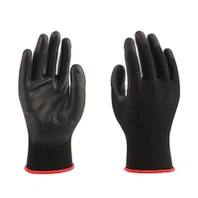
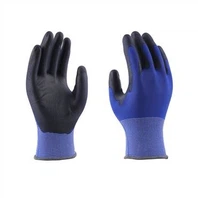
In the construction industry, workers often handle heavy and rough - surfaced materials such as bricks, lumber, and metal pipes. The anti - slip performance of PU palm coated gloves is crucial to ensure that workers can safely grip these materials without the risk of dropping them. For example, when lifting a heavy brick, the glove needs to provide enough friction to hold the brick firmly, even if the surface of the brick is dusty or wet. Our Pu Palm Coated Nylon Glove is specifically designed for such applications. The nylon base provides durability, while the PU coating on the palm offers excellent anti - slip properties.
Manufacturing Industry
In manufacturing, workers may handle small and delicate parts as well as large machinery components. The anti - slip performance of gloves is important to prevent damage to the parts and to ensure the safety of the workers. For instance, when assembling electronic components, a worker needs to have a precise grip on the small parts. Our gloves with a well - formulated PU coating can provide the necessary friction to hold these small parts securely, reducing the risk of misplacement or damage.


Gardening
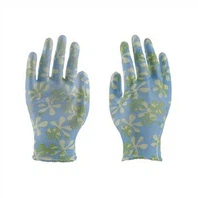
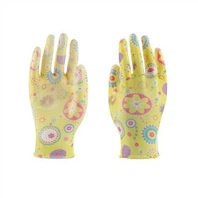
For gardening enthusiasts and professional gardeners, PU Gardening Gloves are a popular choice. Gardening involves handling wet and slippery tools such as shovels, pruning shears, and hoses. The anti - slip performance of the PU coating on these gloves allows gardeners to maintain a firm grip on the tools, even when the tools are covered with soil or water.
Factors Affecting Anti - Slip Performance
Several factors can affect the anti - slip performance of PU palm coated gloves.
Surface Conditions
The surface conditions of the object being held and the environment in which the gloves are used can have a significant impact on anti - slip performance. For example, if the object's surface is wet or oily, the frictional force between the glove and the object may be reduced. However, our PU coatings are designed to be resistant to water and oil to some extent. The hydrophobic nature of the PU coating helps to repel water, maintaining a relatively dry contact surface between the glove and the object. In the case of oil, the coating can be formulated to have a certain level of oil - resistance, which helps to prevent the oil from reducing the friction.
Glove Wear and Tear
Over time, the PU coating on the gloves may wear off due to repeated use and abrasion. This wear and tear can reduce the anti - slip performance of the gloves. To address this issue, we use high - quality PU materials and advanced manufacturing processes to ensure the durability of the coating. Regular inspection of the gloves is also recommended. If the coating shows signs of significant wear, it is advisable to replace the gloves to maintain optimal anti - slip performance.
Temperature
Temperature can also affect the properties of the PU coating. At low temperatures, the PU may become more rigid, which can reduce its ability to conform to the shape of the object and thus decrease the anti - slip performance. On the other hand, at high temperatures, the PU may become softer and more sticky, which can also have an impact on the frictional characteristics. Our research and development team has conducted extensive tests to ensure that our gloves can maintain good anti - slip performance within a wide temperature range.
Comparing with Other Coating Materials
PU palm coated gloves are often compared with gloves coated with other materials such as latex, nitrile, and PVC.
Latex Gloves
Latex gloves are known for their high elasticity and good grip on smooth surfaces. However, they may not perform as well on rough or porous surfaces. The anti - slip performance of latex gloves can also be affected by allergic reactions in some users. In contrast, PU palm coated gloves offer better anti - slip performance on a wider range of surfaces and are generally hypoallergenic.
Nitrile Gloves
Nitrile gloves are resistant to chemicals and punctures. While they have good anti - slip performance, the nitrile coating may not conform as well to the shape of the object as a PU coating. Our PU palm coated gloves can provide a more comfortable and secure grip, especially when handling irregularly shaped objects.
PVC Gloves
PVC gloves are relatively inexpensive and offer some level of anti - slip performance. However, PVC coatings may be more brittle and less durable compared to PU coatings. The anti - slip performance of PVC gloves may degrade more quickly over time, especially under harsh working conditions.
Quality Assurance and Testing
As a supplier, we are committed to providing high - quality PU palm coated gloves with excellent anti - slip performance. We have a strict quality control system in place to ensure that each glove meets our standards.
We conduct various tests on our gloves to evaluate their anti - slip performance. One of the common tests is the coefficient of friction test. In this test, a sample of the glove is placed in contact with a standard test surface, and the force required to move the glove across the surface is measured. The coefficient of friction is then calculated based on this measurement. A higher coefficient of friction indicates better anti - slip performance.
We also perform real - world simulations to test the gloves in different working conditions. For example, we simulate the handling of wet and oily objects to ensure that the gloves can maintain their anti - slip performance in such challenging environments.
Conclusion and Call to Action
In conclusion, the anti - slip performance of PU palm coated gloves is a result of the unique properties of the PU coating and its design to increase friction between the glove and the object being held. These gloves are suitable for a wide range of industries and applications, offering reliable protection and grip.
If you are looking for high - quality PU palm coated gloves with excellent anti - slip performance, we are here to meet your needs. Whether you are in the construction, manufacturing, or gardening industry, our gloves can provide the safety and functionality you require. We offer a variety of glove models, including Pu Palm Coated Nylon Glove, PU Gardening Gloves, and White PU Gloves.
Contact us today to discuss your specific requirements and start a procurement negotiation. We are ready to provide you with the best solutions for your glove needs.
References
- [Researcher's Name]. (Year). "The Relationship between Contact Area and Frictional Force in Glove - Object Interactions." Journal of Industrial Safety and Protection, Volume [Volume Number], Pages [Page Range].
- [Another Researcher's Name]. (Year). "Comparative Study of Anti - Slip Performance of Different Glove Coatings." International Journal of Hand Protection, Volume [Volume Number], Pages [Page Range].